EstiMind · Product Insight
Beyond Planning Poker: Building an Estimation Intelligence Platform
Most estimation tools capture the final number. EstiMind is designed to keep the useful engineering context behind it: assumptions, uncertainty, confidence, disagreement, and the rationale for the decision.
Explore EstiMind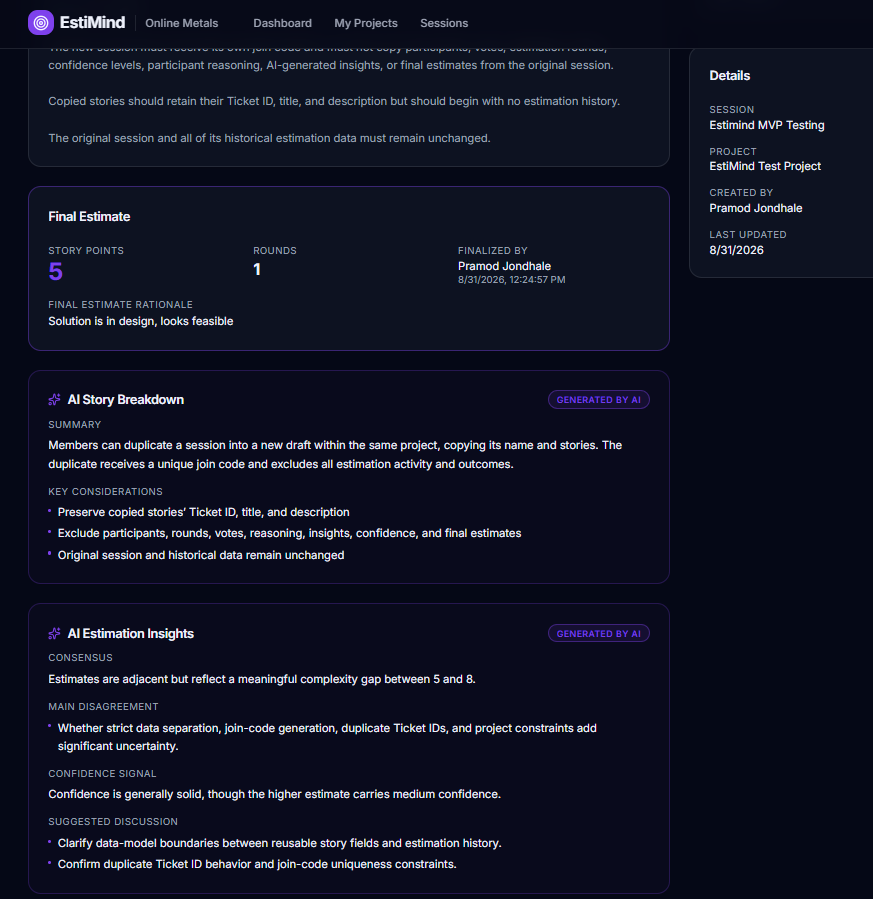
The Problem With Traditional Estimation
Planning Poker often follows a simple pattern: vote, reveal, discuss, forget. The meeting may retain 5, 8, or 13 points, but not the assumptions, technical risks, or uncertainty that produced those numbers. When the final estimate changes, its reasoning can disappear with it.
From Estimation to Estimation Intelligence
EstiMind is not simply a Planning Poker clone. Its workflow preserves estimation context so a team can revisit what it learned, not only what it decided.
Structured Team Estimation
Participants choose from 1, 2, 3, 5, 8, 13, 21, or Abstain. Each estimate is paired with a reason and a confidence signal: High, Medium, or Low. Votes remain hidden until reveal, then the team can discuss the result, create another round, and retain the previous rounds.
Why Reasoning and Confidence Matter
Engineer A: 5 points, high confidence
Engineer B: 8 points, medium confidence
The numbers show disagreement. Reasons and confidence help the team understand its nature: perhaps one engineer sees a dependency, or another is making a different assumption. That is the practical value of estimation intelligence.
AI Story Breakdown
Before voting, EstiMind can generate a concise breakdown of the story: a summary, key considerations, and uncertainties. It helps people inspect the ticket from the same starting point without attempting to estimate it.
AI helps the team understand the story. It does not anchor the team's estimate.
Reveal and AI Estimation Insights
After reveal, EstiMind can synthesize the actual votes, reasons, confidence, and round context into consensus, the main disagreement, a confidence signal, suggested discussion, and round comparison. The purpose is to focus the conversation. AI neither chooses nor recommends the final story points.
Multiple Estimation Rounds
Estimation can continue after the first reveal: estimate, reveal, discuss, and revote. Each revealed round remains available, preserving how the team's understanding evolved instead of overwriting earlier signals.
Human-Owned Final Estimate
The facilitator records the final story points and rationale. EstiMind provides a record of useful context, but the team retains ownership of the decision.
AI provides context. The team makes the decision.
Functional Product Model
Roles and Access
Admin / Owner
Owns the organization, manages projects and members, handles join requests, assigns project access, and has organization-level administration.
Member
An authenticated organization user working in assigned projects. Members create and manage sessions and stories, and facilitate estimation.
Participant
Does not need an account. Participants join one session with a link or join code, provide a name and role, then vote with reasoning and confidence.
Session Lifecycle and Presence
Sessions move from draft to ready, in_progress, and completed. Six-character join codes expire, can be rotated, and are invalidated on completion. Presence can show active, disconnected, or left; reconnecting participants can reuse their session identity while their historical votes remain preserved.
Architecture
The TanStack Start frontend and server-side application layer are deployed on Vercel at estimind.thecodeneuron.dev. Lovable Cloud supplies the Supabase-backed application backend. AI requests run server-side through a provider abstraction.
Technology Stack
AI Architecture and Security
The server-side provider abstraction uses the OpenAI Responses API, with gpt-5.6-sol as the current default model. It powers AI Story Breakdown and AI Estimation Insights; if an AI request fails, estimation can continue. Credentials stay server-side.
Security is not UI-only: Supabase Auth, Row Level Security, backend authorization, and project membership enforcement protect organization data. Disabled members are blocked at the database layer, while anonymous participants receive access only for the session they join.
Building the First MVP
The first MVP of EstiMind is deployed and usable, while the product remains in active development. It validates the core idea: capture reasoning and confidence, preserve rounds, generate AI insights, and keep the final estimate human-owned.